

In this piece · 14 sections
- The valuation question
- How generative engines work with SEO and AI search
- GEO vs. SEO: is generative engine optimization replacing SEO?
- Practical GEO strategies and optimization priorities
- GEO tools and measurement
- Generative engine optimization is not a separate valuation asset
- What buyers can verify
- Where AI search and GEO can improve value
- Where generative AI exposure does not justify a premium
- A practical AI search optimization and valuation audit
- How to present generative search evidence in a sale
- Frequently asked questions
- Continue through the RSW silos
- Get the baseline before pricing the upside
The valuation question
Generative engine optimization, or GEO, is the work of making a brand and its content easier to find, understand, mention, and cite in generative search experiences. That includes Google’s AI Overviews and AI Mode, ChatGPT Search, Perplexity, and other answer systems. In practical digital marketing, GEO focuses on building evidence that both people and machines can verify.
The valuation question is narrower: does that discovery make a website worth more?
Sometimes. The value comes from what the discovery changes, not from the citation itself. If the work creates qualified demand, adds a new acquisition channel, improves conversion paths, or makes the brand more discoverable across the web, it can reduce risk and strengthen future cash flow. If it produces screenshots with no attributable visits or revenue, the valuation case is weak.
How generative engines work with SEO and AI search
Generative engines use information retrieval and a large language model to assemble an answer from indexed pages, trusted sources, and the context of a query. Instead of returning only traditional search results, an answer engine may summarize several sources inside one response. That is why AI-generated answers can cite a page even when its conventional search ranking is not first.
Traditional SEO still matters because a traditional search engine needs crawlable, understandable content before AI systems can retrieve it. Search engine optimization focuses on technical access, intent, authority, page quality, and useful coverage. AI engines add another presentation layer: generative AI models select passages, combine evidence, and produce AI-generated responses that may answer the question before a click.
To optimize for generative AI, prioritize the same durable assets a buyer can verify. Use clear headings, answer the core question early, create content with original evidence, and keep important facts consistent across the site. Those SEO strategies help traditional search and AI-driven search without pretending that any publisher controls the generated answer.
GEO vs. SEO: is generative engine optimization replacing SEO?
No. SEO and GEO overlap because both depend on accessible pages, clear meaning, authority, and satisfied search intent. SEO focuses on ranking and clicks from search engine results pages. GEO also asks whether passages can appear in AI answers with accurate attribution. Unlike traditional search, an assistant can combine several sources into one response; unlike traditional search engines, it may show fewer visible links.
That shift in search changes measurement, not the fundamentals. Optimizing for generative AI search should make your content more useful and easier for AI to interpret without hiding information from readers. Generative engines prioritize content they can retrieve and support, but the exact selection process remains outside a publisher's control.
The durable strategy is to optimize content for generative discovery and conventional search at the same time. If a tactic improves only engine visibility while making the page worse for people, it is unlikely to be a transferable asset.
Practical GEO strategies and optimization priorities
Good optimization strategies start with the questions real buyers ask. Ensure your content answers each question directly, identifies the author and source, distinguishes facts from estimates, and links to the underlying evidence. Make your content easy to quote by keeping definitions, methods, and limitations explicit.
Then improve the technical layer. Confirm that important pages can be crawled, rendered, and indexed; use descriptive titles and internal links; consolidate conflicting claims; and maintain stable URLs. These steps can improve search visibility across Google Search and other search platforms without special markup designed only for a generative model.
Finally, build information gain. Original datasets, experiments, calculators, firsthand examples, and expert review give generative AI systems a reason to select the page. The goal is not to influence generative output through repetition. It is to publish verifiable material that deserves to be featured in generative results.
GEO tools and measurement
AI tools can monitor mentions, cited URLs, prompts, and competitors across services like ChatGPT and Perplexity. Generative AI tools are useful for observation, but their proprietary scores are not buyer receipts. Search Console, analytics, server logs, CRM events, and revenue records remain the stronger evidence stack.
Measure generative search platforms with a fixed, dated prompt set. Track mention accuracy, citation share, referred sessions, assisted conversions, branded searches, and changes to the cited pages. That makes questions about GEO measurable while acknowledging that generative search results can vary by model, location, and time.
No tool can guarantee visibility in generative AI search. A monitoring platform can show where a brand appears in AI, while first-party data shows whether those appearances changed business outcomes. Use both views and disclose gaps.
Generative engine optimization is not a separate valuation asset
Google's current generative AI optimization guide is unusually direct: from Google's perspective, AEO and GEO are still SEO. Its generative Search features use retrieval from the Search index and query fan-out, where one question produces multiple related searches.
That matters because a buyer is not acquiring a magic “GEO score.” The buyer is acquiring the site, content, domain, brand, data, audience relationships, and operating system that earned the discovery.
Those underlying assets may be valuable. A library of original research can attract links and citations. A recognized brand can be mentioned even when its page is not the top blue link. A clear information architecture can help both humans and retrieval systems find the right answer. None of those benefits require inventing a new asset class.
The clean valuation treatment is to trace AI-search performance into familiar drivers:
- Traffic: Did it add discoverable, attributable visits?
- Conversion: Did those visitors subscribe, request a valuation, buy, or return?
- Diversification: Did it reduce dependence on one search result or one platform?
- Brand strength: Did mentions create branded searches, direct demand, or third-party recognition?
- Transferability: Can a buyer keep the discovery after ownership, editorial, and technical changes?
If those links cannot be shown, AI-search exposure belongs in the opportunity narrative, not in the base valuation.
What buyers can verify
A buyer can verify revenue, traffic sources, landing pages, conversions, content ownership, backlinks, and analytics access. AI citations are harder. Answers change by model, geography, account state, prompt wording, and time.
That volatility is visible in current research. An Ahrefs study of 863,000 keyword result pages and four million AI Overview URLs found that 37.9% of cited URLs appeared in the first ten result blocks for the same query. A citation and a conventional top-ten ranking overlapped often, but far from always.
This is not proof that a citation has no value. It is evidence that AI-search exposure is a different and less stable measurement surface. A buyer should capture it as an observation with a date, prompt set, model, market, and result—not as an evergreen rank.

The same standard applies to referral traffic. In an Ahrefs analysis of 3,000 websites, 63% received at least one attributable AI visit, but chatbot referrals averaged 0.17% of traffic in the sample. ChatGPT accounted for half of the attributable AI traffic reported there.
That study is a useful benchmark, not a forecast for an individual site. It also notes that some AI visits may be classified as direct. The defensible claim is that AI referrals exist and can matter disproportionately to some small sites. It is not that AI discovery will add a fixed percentage to traffic or value.
Where AI search and GEO can improve value
1. It can diversify discovery
A site dependent on one ranking is fragile. If the same useful content is found through classic search, AI answers, third-party mentions, YouTube, branded search, and direct navigation, the discovery mix is broader.
Diversification matters in marketplace valuation. Flippa's live website valuation methodology explicitly considers traffic trend and traffic-source distribution alongside profit, content quality, backlinks, site age, revenue mix, and owner involvement.
That does not mean Flippa assigns a “GEO multiple.” It means verifiable diversification is already a recognized risk factor. AI discovery can contribute if it is large enough, stable enough, and measured correctly.
2. It can increase the value of original content
Commodity explainers are easy to replace. Original datasets, calculators, experiments, expert commentary, and clearly documented methods are harder to reproduce. They also give answer systems something specific to cite.
A buyer may reasonably value that content library more highly because replacement cost is higher and because it supports multiple channels. The evidence is the asset itself, its links and mentions, its conversion record, and the documented production process—not a promise that an LLM will keep citing it.
3. It can strengthen branded demand
Repeated accurate mentions may cause people to search for the brand later, visit directly, or include it in a shortlist. That path is difficult to attribute perfectly, but it can appear in branded-query trends, direct traffic, assisted conversions, and customer surveys.
This is where those mentions may matter even when referral clicks stay small. A trusted recommendation can influence a decision without being the last click. Buyers should still demand evidence over a meaningful period and compare it with seasonality and marketing activity.
4. It can improve conversion quality
An AI answer may pre-qualify a visitor by explaining the category before the click. Google says visitors arriving from pages with AI Overviews may be more engaged, but it has not published enough methodology to turn that claim into a universal assumption.
Use first-party analytics instead. Compare landing-page engagement, valuation starts, completed reports, email signups, and revenue by source where the data is available. If the sample is small, label it small.
A practical AI search optimization and valuation audit
Start with a dated inventory. Record the prompts and topics where the brand appears, the cited URLs, the answer platform, and whether the mention is accurate. Save raw exports where the monitoring product permits it.
Then connect the observations to owned evidence:
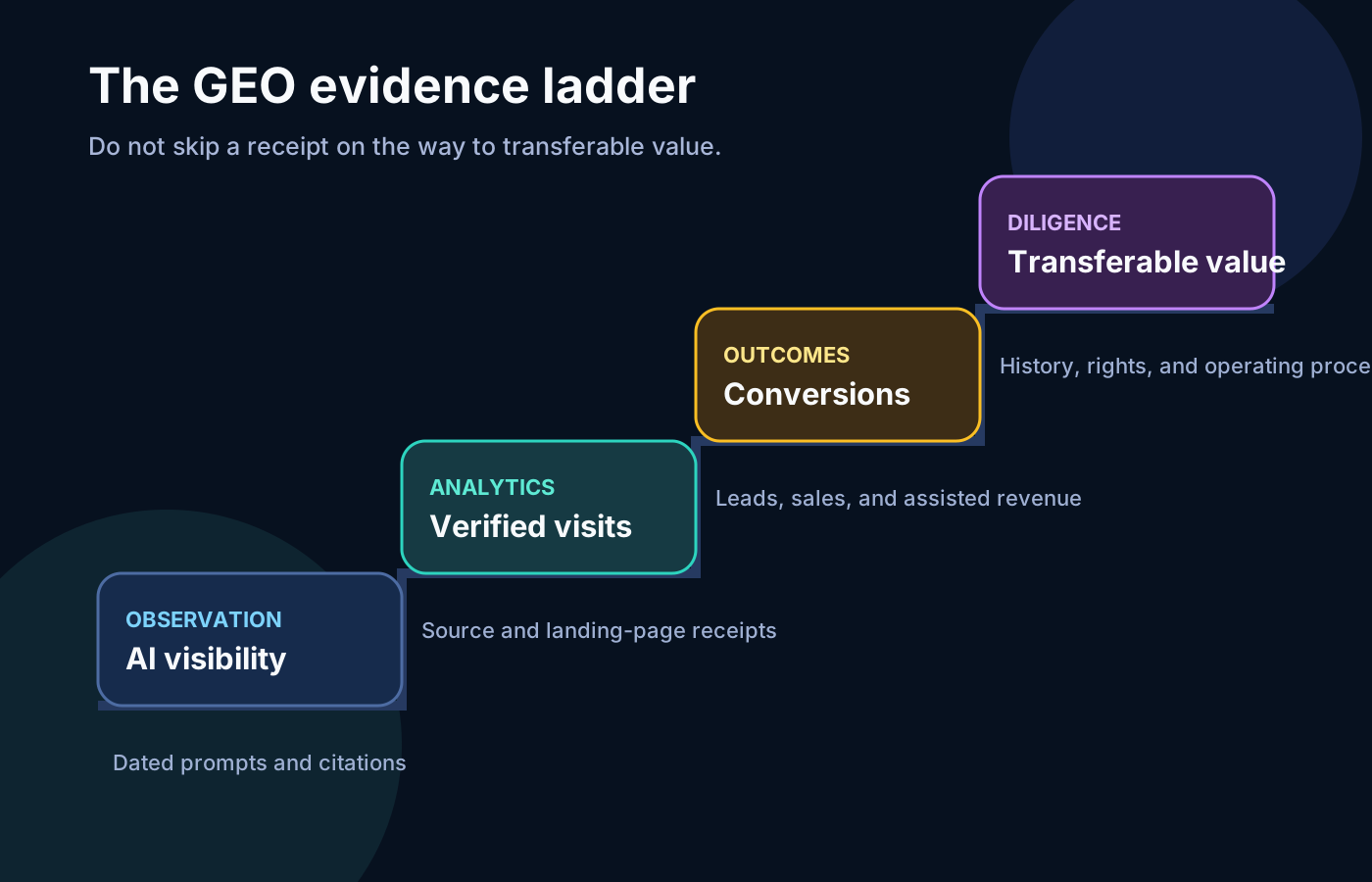
Finally, reconcile the new channel with the rest of the business. A site with weak profit, declining search demand, and undocumented operations does not become valuable because an assistant cited it. A healthy business with original assets and an emerging, measurable discovery channel has a stronger case.
How to present generative search evidence in a sale
Put generative-search evidence in the traffic and brand sections of the sale package. Show the method, not just the best screenshots.
Include:
- the monitored prompt set and why it reflects buyer intent;
- the models, markets, and dates covered;
- cited pages and mention accuracy;
- attributable visits and conversions;
- known direct-traffic or referrer limitations;
- editorial and technical processes that sustain discovery;
- material volatility or lost citations.
That package lets a buyer judge the upside without forcing it into the earnings multiple. If performance survives long enough to influence normalized revenue or durable brand demand, value can follow through the normal valuation model.

Frequently asked questions
Does GEO directly increase a website's sale multiple?
Not by itself. GEO can strengthen the factors behind a multiple, such as diversified traffic, brand demand, original content, and qualified conversions. There is no standard, evidence-backed “GEO multiple.”
Are AI citations transferable to a buyer?
The pages, domain, brand, and editorial systems can transfer. The citation itself is controlled by an outside platform and may change at any time. Treat transferability as an evidence question, not a guarantee.
Should AI referral traffic be included in a valuation?
Yes, if it is real, measured consistently, and included once. Reconcile it with total traffic and normalized revenue. Do not add a second premium for the same visits.
Is GEO more valuable than traditional SEO?
That comparison is usually false. Google's own guidance treats generative discovery as an extension of search fundamentals. The stronger strategy builds assets that work across classic search, AI answers, direct demand, and third-party mentions.
How long should GEO performance be tracked before a sale?
There is no universal minimum. A buyer will trust a longer, consistent history more than a short spike. Preserve weekly or monthly records and disclose major model, tracking, content, or technical changes.
Can a small website benefit from GEO?
Yes. Smaller sites can earn citations and qualified visits, particularly around specific expertise. The absolute traffic may still be small, so judge it by actual outcomes rather than visibility alone.
Continue through the RSW silos
Use the website valuation complete guide as the valuation hub, then compare AI-search exposure with traffic concentration risk. The social-signals framework helps separate citations from transferable audience evidence.
Current valuation multiples keep the economics grounded. RSW's public methodology explains the evidence boundaries, and the free website value calculator supplies the baseline before any GEO upside is discussed.
Get the baseline before pricing the upside
Generative engine optimization is a discovery strategy. Website value still begins with earnings, traffic quality, risk, transferability, and the strength of the underlying assets.
Run a Real Site Worth estimate to establish an evidence-based starting range. Then place verified GEO performance where it belongs: inside the traffic, brand, content, and risk analysis—not above it as an unsupported premium.
- Google Search Central — Optimizing your website for generative AI featuresdevelopers.google.com
- Ahrefs — 38% of AI Overview citations pull from the top 10ahrefs.com
- Ahrefs — AI traffic study of 3,000 websitesahrefs.com
- Flippa — Website Valuation Calculator methodologylanding.flippa.com

Every live article in the AI search and website value silo
GEO, AEO, LLM SEO, ChatGPT, and AI Overview evidence for website valuation and acquisition diligence.
