

In this piece · 18 sections
- The valuation question
- What is LLM SEO?
- LLM SEO vs. traditional SEO
- LLM SEO best practices buyers can verify
- Tracking LLM SEO performance
- How large language models process SEO content
- Define the systems before testing them
- Step 1: establish control of the domain and infrastructure
- Step 2: verify normal crawl and index health
- Step 3: test AI-search access independently
- Step 4: separate citation evidence from traffic evidence
- Step 5: inspect the content assets behind citations
- Step 6: test transferability
- Red flags that deserve a discount
- A buyer's evidence table
- Frequently asked questions
- Continue through the RSW silos
- Value the foundation, not the screenshot
The valuation question
LLM SEO due diligence is the technical and commercial audit of whether a website can be discovered, retrieved, cited, measured, and maintained across AI-assisted search.
The point is not to certify that a site “ranks in every LLM.” No seller controls that outcome. The point is to determine whether the owned foundation works, whether the seller's claims are reproducible, and whether the buyer receives the access and documentation needed to keep it working.
This audit belongs beside financial, traffic, content, legal, and operational diligence. It does not replace them.
What is LLM SEO?
LLM SEO is the practice of making useful, authoritative content discoverable and accurately attributable inside AI-generated answers. It connects traditional search engine optimization with the retrieval and citation behavior of large language models. The owned goal is not to control LLM outputs; it is to create content that search engines and LLMs can access, understand, and support.
Large language model optimization is also described as AI SEO, generative engine optimization, or GEO. The labels overlap. Effective LLM SEO still depends on technical SEO, useful pages, clear entities, original evidence, credible mentions, and a strong internal-link structure.
AI tools like ChatGPT, Claude, and Perplexity can produce different answers to the same keyword or prompt. One model may cite the site while another does not. That is why LLM performance must be measured as a variable observation rather than treated like a fixed search ranking.
LLM SEO vs. traditional SEO
Traditional SEO focuses on ranking in Google and other search engines, earning clicks from search results, and satisfying query intent. LLM SEO focuses on whether AI systems can retrieve a relevant passage, trust its evidence, and cite it accurately inside AI answers. The second job differs from traditional SEO in presentation, but not in its need for accessible, high-quality source material.
Traditional search engines usually expose a ranked list of links. AI-powered search may summarize several sources before a click. SEO and LLM optimization therefore share crawl, index, authority, and content-quality signals while using different discovery metrics.
For a buyer, the practical SEO vs. LLM SEO distinction is evidence. Traditional SEO performance can be checked through rankings, Search Console, analytics, and revenue. AI visibility needs dated prompts, cited URLs, platform details, referral data, and repeated observations across Google AI Overviews, ChatGPT Search, Claude, and Perplexity.
LLM SEO best practices buyers can verify
Start with normal SEO best practices. Keep important pages indexable, place definitions and evidence in rendered HTML, use descriptive headings, link related concepts, and resolve duplicate or conflicting pages. Those SEO strategies make content easier to retrieve without creating a parallel site for AI crawlers.
Next, optimize passages for accuracy. Define the claim, measurement period, source, and limitation together. Create content with original data, worked examples, or expert review when those assets improve the reader's decision. Do not repeat keywords merely to get cited by AI.
Finally, measure the channel. Track whether the brand appears in AI, which URLs are cited by AI, the accuracy of AI summaries, traffic from AI, and the conversions that follow. These are business receipts; a proprietary monitoring score is only a directional signal.
Tracking LLM SEO performance
Use a fixed set of commercial and informational prompts. Large language models process each query with different retrieval context, so record the model, market, account state, cited URL, and date. Include the phrases people search, not only prompts engineered to produce the brand.
Track conventional ranking and LLM citations in parallel. Ranking on Google, Search Console clicks, and analytics sessions explain traditional acquisition. Repeated citations, AI referrals, brand searches, and conversions show whether LLMs add a distinct channel.
Third-party sources can affect the result. A forum like Reddit, an industry publication, or a customer review may support a brand mention even when the owned page is not cited. Map those mentions before assuming on-site SEO work produced the answer.
How large language models process SEO content
Large language models process retrieved passages and prompt context to construct an answer. They do not browse or rank every page in the same way. Some AI models rely on a search index, while others use provider-specific retrieval, licensed data, or a user-triggered fetch.
SEO content can reach these AI systems through traditional search indexes, AI crawlers, or direct retrieval. That is why search engines like Google, ChatGPT Search, and other products must be tested separately. A page blocked from one route may remain available through another.
To optimize responsibly, keep the source accessible, factual, well structured, and easy to attribute. Clear SEO signals can help discovery, but no publisher can guarantee that an LLM will select a passage or preserve its context.
Define the systems before testing them
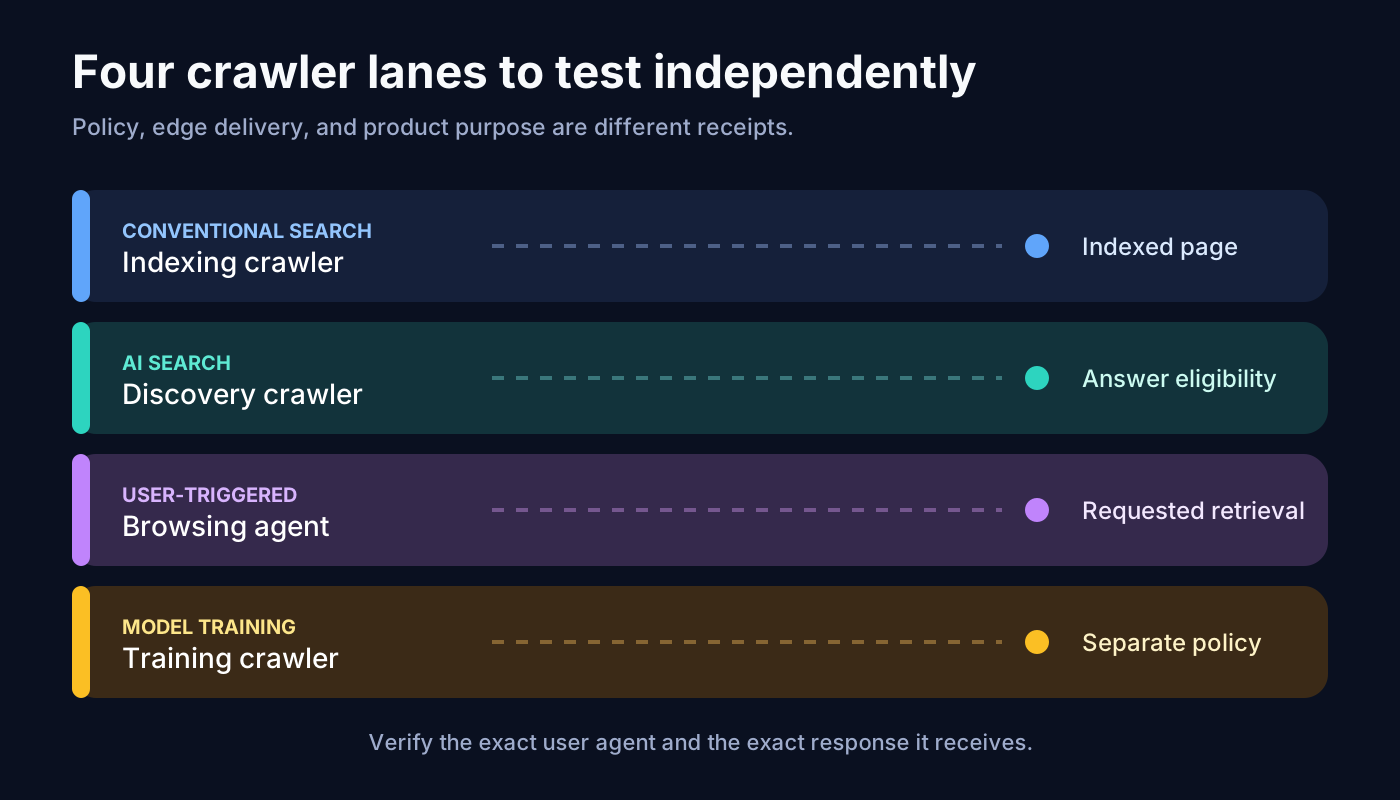
“AI crawler” is too broad to be a useful diligence category. A provider may operate separate systems for search discovery, model training, and real-time user retrieval.
Cloudflare's current AI crawler reference lists distinct OpenAI agents including GPTBot, OAI-SearchBot, and ChatGPT-User. It also distinguishes Claude and Perplexity search crawlers from user-triggered agents.
Those purposes create different business decisions:
A blanket allow or block can produce unintended results. A seller may believe it blocked training while actually blocking search. A CDN may allow a user agent in robots.txt and still challenge it at the edge.
Step 1: establish control of the domain and infrastructure
Before interpreting crawler behavior, confirm that the seller controls the systems that determine it.
Request read-only or supervised access to:
- domain registrar and DNS configuration;
- CDN, WAF, and bot-management settings;
- hosting and deployment platform;
- source repository and production branch;
- robots.txt generation logic;
- XML sitemaps;
- Google Search Console and Bing Webmaster Tools;
- analytics and, where available, server or edge logs.
Flippa's current due-diligence checklist recommends direct or read-only analytics access, ownership verification, and reconciliation of monetization claims. Apply the same standard here. Screenshots chosen by the seller are not equivalent to access.
Confirm what transfers. A search console property, Cloudflare account, analytics property, image license, author agreement, or external dataset may belong to the seller personally or to an agency. List every dependency and the transfer mechanism.
Step 2: verify normal crawl and index health
AI-search discovery rests on ordinary technical foundations. Google's crawling and indexing documentation covers the controls that let Google find and process content, including URL structure, sitemaps, crawl management, and indexable files.
Test a representative sample of:
- the homepage;
- core product or calculator pages;
- top traffic articles;
- recently published pages;
- pages the seller claims receive AI citations;
- pages behind JavaScript rendering;
- image-heavy and data-heavy posts.
For each URL, record:
- final status code and redirect chain;
- canonical URL;
- robots meta and HTTP-header directives;
- robots.txt access;
- rendered main text;
- internal-link path from an indexed page;
- sitemap inclusion and last-modified accuracy;
- index status and last crawl where the platform exposes it.
Do not accept an origin 200 as proof if the public edge returns a maintenance page, bot challenge, or 503. Test from outside the seller's authenticated session and through the production hostname.

Step 3: test AI-search access independently
Google says a page must be indexed and eligible to appear with a snippet to qualify as a supporting link in AI Overviews or AI Mode. Its AI features documentation says there are no additional technical requirements and no special AI schema.
That simplifies the Google lane: validate normal Search eligibility, then inspect any preview controls such as nosnippet, data-nosnippet, max-snippet, and noindex.
Other providers need their own tests. OpenAI's publisher FAQ says publishers should avoid blocking OAI-SearchBot if they want content included in ChatGPT summaries and snippets. It also notes that a disallowed page's title and link may still surface in described cases unless noindex is readable.
The diligence lesson is not “allow everything.” It is to document the intended policy and confirm that the implementation matches it.
Check four layers:
- robots.txt: Is the relevant agent allowed for the intended path?
- page directives: Do meta tags or headers restrict indexing or snippets?
- edge controls: Does the CDN/WAF block, rate-limit, challenge, or serve a different response?
- application behavior: Can the crawler receive meaningful text without login, cookies, or unsupported JavaScript?
Cloudflare's AI Crawl Control documentation shows that site owners can inspect crawler requests and apply allow or block actions. That means the buyer needs the policy configuration, not just the public robots file.
Step 4: separate citation evidence from traffic evidence
Ask the seller for the prompt, platform, model or product, market, account state, date, cited URL, and saved output behind each citation claim.
Then reproduce a sample without treating a changed answer as fraud. Generative answers are variable. The purpose is to understand how the seller monitored exposure and whether the cited pages still exist and remain accurate.
For traffic, inspect analytics source and medium, landing pages, engagement, and conversion events. Check whether links use recognizable referrers and whether redirects strip attribution.
GA4 documentation explains that missing referral information, stripped UTM parameters, redirects, URL shorteners, and blockers can move visits into direct traffic. AI referral measurement can therefore undercount real visits.
That limitation cuts both ways. It is a reason to investigate, not a license to invent traffic. If a seller cannot show attributable visits or a documented measurement experiment, classify the claim as unverified.
Step 5: inspect the content assets behind citations
An AI answer may cite a page because of an original dataset, a clear definition, a comparison table, an expert quote, or a third-party mention. Identify the asset doing the work.
For every high-value page, check:
- author identity and rights to retain the byline;
- source licenses and permissions;
- ownership of charts, screenshots, and images;
- update cadence and source-monitoring process;
- internal links and supporting cluster pages;
- backlinks and material third-party mentions;
- calculators, data pipelines, or APIs the page depends on;
- accuracy of claims likely to be extracted without surrounding context.
Commodity text is easy to replace and easy for competitors to reproduce. Original research, live tools, transaction evidence, and well-maintained methods are more defensible. The buyer should value the owned system, not the temporary answer output.
Step 6: test transferability
A technically healthy site can still be a poor acquisition if the performance depends on the seller.
Ask:
- Are expert quotes tied to the seller's personal credentials?
- Do third-party publications mention the individual or the transferable brand?
- Are monitoring tools licensed to the business?
- Will analytics history transfer intact?
- Are crawler policies version-controlled or manually configured in a personal account?
- Can a new editor update the content using documented sources and rules?
- Do vendors, data feeds, or APIs permit assignment?
Document the post-close action list. A buyer should know which credentials rotate, which integrations reconnect, which console properties need verification, and which policy changes risk a recrawl or discovery shift.
Red flags that deserve a discount
The seller reports “LLM traffic” with no source definition
Ask for the exact report, dimensions, filters, and date range. A dashboard label may combine referrals, direct traffic estimates, impressions, mentions, and citations.
Robots.txt and the CDN disagree
The public file allows a crawler, but the WAF returns a challenge or forbidden response. The site is not accessible merely because the policy text looks correct.
Citation pages depend on unlicensed assets
If the seller cannot transfer a dataset, image, or expert contribution, the buyer may need to remove the material that earned citations.
The site has many overlapping AI-search pages
Near-duplicate AEO, GEO, LLMO, and “AI SEO” pages may compete with one another and create scaled-content risk. Map intents and canonical targets before accepting the content count as an asset.
The seller values screenshots as recurring revenue
Exposure can be an opportunity. Without durable measurement and conversion evidence, it should not be capitalized like contracted income.
A buyer's evidence table

Frequently asked questions
Is llms.txt required for LLM SEO?
Google says it does not use llms.txt or special AI markup for generative Search. Other tools may choose to read different files, but a voluntary file does not replace crawlability, indexing, clear content, or provider-specific controls.
Should a buyer allow every AI crawler?
No. Search, user retrieval, and training are distinct purposes. Choose a content policy, document it, and configure each relevant system consistently.
Can one citation prove an article is optimized?
No. It proves that one answer included the page at one moment. Durable performance needs repeated observations, accurate mentions, traffic or brand evidence, and a transferable content foundation.
What is the most important technical test?
Verify the public response each crawler can actually receive. A correct robots file is irrelevant if the edge blocks the agent or the application returns no meaningful content.
How should LLM performance affect a purchase price?
Include verified traffic and conversion in normalized performance once. Treat volatile or unmeasured citations as opportunity. Discount technical debt, concentration, and owner-dependent assets.
Does ChatGPT referral traffic always appear in analytics?
No. Some visits may lose referrer information and appear as direct. Use analytics, redirect checks, and server or edge logs where available, and disclose measurement limits.
Continue through the RSW silos
Pair this audit with Wayback-history diligence, traffic concentration analysis, and the privacy and security value review. Buyers of editorial properties should also use the content-site valuation guide.
The website valuation pillar connects those risks to the range; domain-only assets route to the same website valuation while domain appraisal is paused.
Value the foundation, not the screenshot
LLM SEO diligence is a test of owned systems: discovery, access, content quality, measurement, and transferability. Those systems can support value even as answer products change.
Establish the website's baseline value first. Then adjust for verified channel performance, durable content assets, concentration, technical remediation, and transfer risk.
- Google Search Central — Crawling and indexingdevelopers.google.com
- Google Search Central — AI features and your websitedevelopers.google.com
- OpenAI — Publisher and developer FAQhelp.openai.com
- Cloudflare — AI crawler referencedevelopers.cloudflare.com
- Cloudflare — Manage AI crawlersdevelopers.cloudflare.com
- Flippa — Due diligence checklistflippa.com

Keep moving through the AI search and website value silo
GEO, AEO, LLM SEO, ChatGPT, and AI Overview evidence for website valuation and acquisition diligence.

