

In this piece · 16 sections
- The valuation question
- How AI Overviews work in Google Search
- AI Overviews SEO vs. traditional SEO
- How to optimize content for AI Overviews
- AI Overviews change the surface, not the concentration owner
- What Google lets site owners measure
- How to measure AI Overview performance
- Citation patterns can diverge from normal rankings
- Do AI Overviews reduce website traffic?
- Diagnose the cause before applying a discount
- How AI Overview risk enters a valuation
- A concentration schedule for a sale package
- Reduce risk before a sale
- Frequently asked questions
- Continue through the RSW silos
- Measure the dependency before pricing it
The valuation question
Google AI Overviews sit above or among conventional search results and synthesize information with links to supporting pages. For publishers, that can produce new citations, different click behavior, or fewer reasons for a user to leave the result page.
For buyers and sellers of websites, the important question is not whether AI Overviews are good or bad in general. It is how much of this business depends on Google discovery, how that dependence is changing, and whether the effect is visible in the site's own evidence.
How AI Overviews work in Google Search
AI Overviews are AI-generated summaries that can appear near the top of search results. Google’s systems may use query fan-out to run related searches, retrieve supporting pages, and assemble an answer with links. An AI Overview can therefore cite a page that is not the first conventional result for the exact keyword.
The feature is part of Google Search, not an independent traffic source. AI Overviews appear for informational queries and other searches where an AI-generated response may help. AI Mode provides a broader conversational search experience, but both surfaces still depend on Google's index and ranking systems.
For valuation, this distinction matters. Appearing in AI Overviews may change clicks and search visibility, yet the website remains exposed to one search engine. Track the surface separately while retaining Google as the parent concentration category.
AI Overviews SEO vs. traditional SEO
Traditional SEO and AI Overview optimization share the same foundation. A page must be crawlable, indexable, useful, and eligible for a snippet. Technical SEO, on-page SEO, original evidence, clear authorship, descriptive internal links, and strong page experience remain the core SEO strategies.
The measurement layer differs. Traditional search offers rankings, impressions, and clicks across a results page. AI-powered search can combine sources inside AI summaries, making citation presence and answer accuracy additional signals. A conventional search ranking alone does not show every URL cited in AI Overviews.
Do not treat AI SEO as a separate asset class. Buyers should evaluate the content, brand, data, links, tools, and editorial process that support both SEO success and AI visibility.
How to optimize content for AI Overviews
You cannot trigger AI Overviews or guarantee that a page will be featured in AI Overviews. You can optimize your content so that people and retrieval systems can understand and verify it.
Use these SEO best practices:
- Answer search intent early. Define the question, direct answer, evidence, and limitation in the same section.
- Create content with information gain. Original data, calculators, expert review, comparisons, and firsthand examples are harder to replace than generic summaries.
- Use structured content. Clear headings, concise definitions, tables, and descriptive links make relationships easier to inspect.
- Keep claims consistent. Conflicting prices, dates, names, or methods weaken trust across the site.
- Maintain technical access. Confirm canonical tags, rendering, crawl rules, and public-edge responses instead of relying on an origin health check.
- Earn credible mentions. Third-party sources can shape which entities and pages appear in AI-generated summaries.
Optimizing for AI Overviews requires the same editorial restraint as strong SEO and content marketing. The goal is to make content easier for AI to retrieve without making it repetitive or less useful to readers.
AI Overviews change the surface, not the concentration owner
Google's AI features documentation explains that AI Overviews and AI Mode may use query fan-out, issuing multiple related searches to assemble a response. Pages must be indexed and eligible to appear with a snippet to qualify as supporting links.
That creates more possible citation paths. It does not turn Google traffic into a separate independent channel.
If most of a site's sessions come from Google, the business is highly dependent on Google whether those users arrive from a classic result, an AI Overview citation, an image result, or another Google surface. The interfaces can perform differently, but the platform concentration remains.
This distinction prevents false diversification. A seller should break Google traffic into useful surfaces for analysis while preserving the parent concentration in the valuation report.
What Google lets site owners measure
Google historically included AI-feature activity inside Search Console's web performance data. In June 2026, it announced dedicated generative-AI performance reports for a subset of websites, covering impressions in generative Search and Discover experiences.
The rollout creates a more specific visibility view where available. It does not solve every attribution question.
A useful evidence pack includes:
- total Google impressions and clicks;
- dedicated generative-AI impressions if the property has the report;
- queries and landing pages gaining or losing visibility;
- device and market where available;
- Search Console clicks reconciled with analytics sessions;
- conversion and revenue by landing page;
- annotation of core updates, site changes, outages, and content releases.
Do not infer “no AI Overview exposure” merely because the dedicated report is absent. The feature began as a limited rollout, and overall performance reporting still contains Google Search activity.
How to measure AI Overview performance
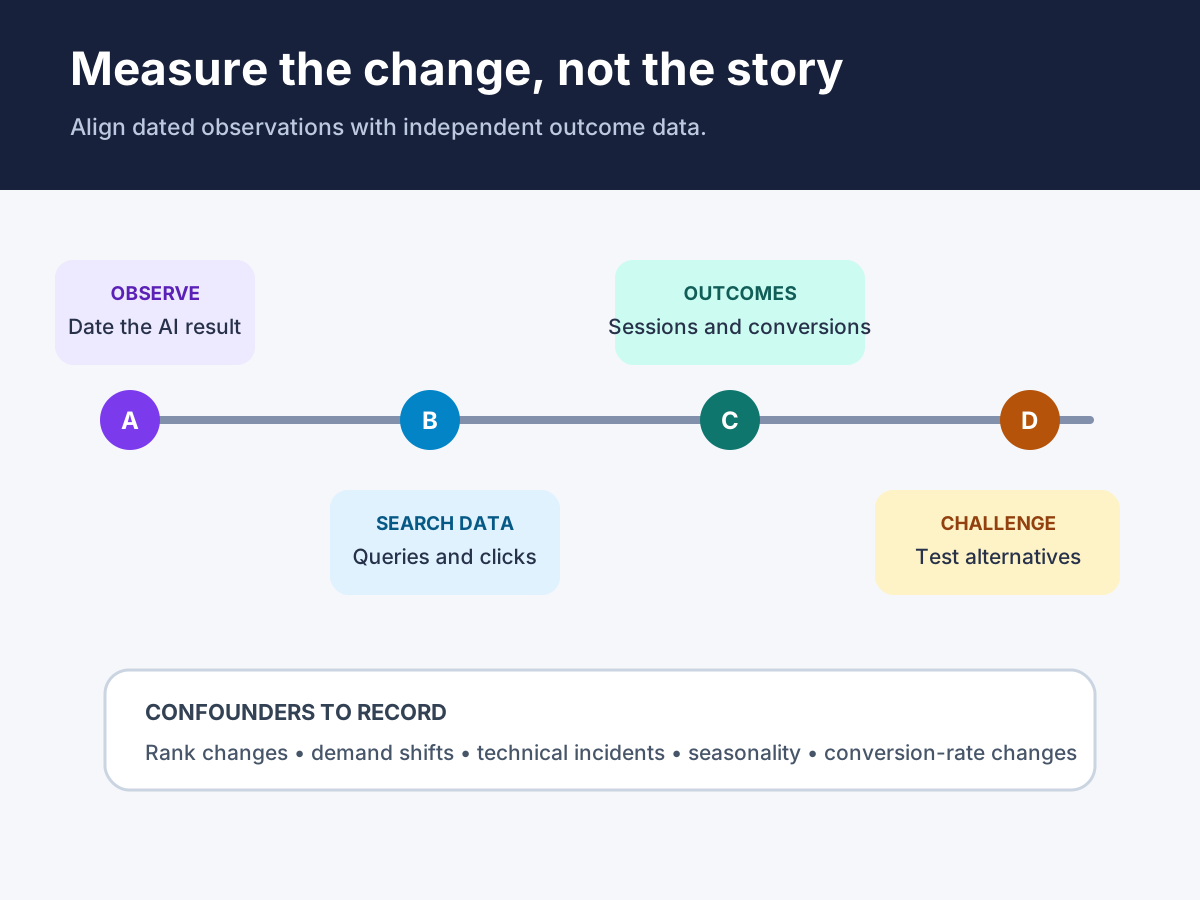
Build a dated query set around informational and commercial search intent. For each query, record whether an overview appears, the AI Overview sources, the page's normal ranking, and whether the brand appears in AI-generated summaries. Keep the result with the market, device, date, and interface.
Then compare those observations with Google Search Console, analytics, and revenue. Track search queries, search rankings, clicks, landing pages, conversions, and branded demand. That evidence shows whether the impact of AI is limited to the results page or reaches the business.
AI tools can monitor citation changes, but no platform can tell Google which page to select. AI systems and AI models change over time. Treat visibility in AI as a sampled metric and preserve the raw observations behind every trend line.
This measurement belongs inside the wider content strategy. Compare AI-driven search with classic search, email, direct visits, paid acquisition, and referrals so one new surface is not mistaken for channel diversification.

Citation patterns can diverge from normal rankings
In March 2026, Ahrefs published an analysis of 863,000 keyword result pages and four million AI Overview URLs. It found that 37.9% of cited URLs appeared in the first ten result blocks for the same query.
The rest were split between lower positions and URLs beyond the first 100 blocks. YouTube accounted for 5.6% of all cited URLs in the sample and 18.2% of cited URLs that did not rank in the top 100 for the same keyword.
Those figures are specific to Ahrefs' dataset and methodology. They support a practical diligence conclusion: conventional rank tracking alone does not capture every AI Overview citation opportunity or risk.
Track both:
- the site's normal query and page performance;
- the pages and third-party surfaces cited in generative results.
If third parties repeatedly define the brand inside AI answers, the owned site may have a representation gap even while organic rankings look healthy.
Do AI Overviews reduce website traffic?
The honest answer is that the effect varies by query, page, intent, answer completeness, link treatment, and time.
An informational query with a complete on-page answer may produce fewer clicks. A complex comparison may produce a more qualified click because the user wants evidence or a tool. A branded or transactional query behaves differently again.
Ahrefs reported an original-data study of 81,947 websites in which average search traffic fell by about 21% while attributable AI traffic grew roughly 9.7 times. The researchers caution that AI Overview and AI Mode traffic is still mixed into “Search” in analytics, so the comparison is imperfect.
Do not apply those averages to an individual valuation. Use them to justify a closer review of the site's own trend and measurement design.
The valuation effect comes through actual changes in:
- click-through rate;
- sessions;
- conversion rate;
- revenue per visitor;
- branded demand;
- traffic concentration;
- content and acquisition cost.
A fall in clicks with stable revenue may be less damaging than a fall in revenue. A rise in impressions with no visits may still support awareness, but that needs different evidence.
Diagnose the cause before applying a discount
Google's traffic-drop debugging guide lists several causes: algorithmic updates, technical problems, spam issues, seasonality, changing interest, and site moves.
AI Overviews are one possible mechanism inside a changing search environment. They are not the default explanation for every decline.
Use a structured diagnosis:
1. Compare impressions and clicks
- Impressions stable, clicks down: investigate click-through rate, result presentation, answer completeness, and competing features.
- Impressions and clicks down: investigate ranking, demand, indexing, technical health, and policy issues.
- Clicks stable, conversions down: investigate intent, page experience, tracking, offer, and traffic mix.
2. Segment pages and queries
Find whether the change is site-wide, silo-wide, or concentrated in one page. Separate informational definitions from transactional calculators and branded queries.
3. Check time and external events
Compare year over year where seasonality matters. Annotate Google core updates and confirmed incidents. Review the public Search Status Dashboard during suspicious periods.
4. Review site changes
Check migrations, canonical tags, robots rules, rendering, redirects, templates, internal links, and analytics releases. A deployment defect can resemble a platform shift.
5. Inspect the answer surface
For material queries, record whether an AI Overview appears, which pages it cites, whether the site's page is represented accurately, and whether the cited source changes over time.
How AI Overview risk enters a valuation
Earnings risk
If lower Google clicks reduce normalized revenue, the effect already belongs in the earnings history. Avoid adding a second arbitrary “AI discount” to the same decline.
Concentration risk
High dependence on Google deserves attention even before a decline. Measure the share of sessions, leads, and revenue tied to Google, then identify concentration in the top pages and query families.
Measurement risk
If the seller cannot separate Search Console clicks, analytics sessions, conversion events, and revenue, the buyer has less confidence in the story. Missing dedicated generative reporting may be a platform limitation; missing basic first-party access is a diligence problem.
Content risk
Thin pages that merely restate common answers are easier for a result page to satisfy without a click. Original tools, primary data, detailed methods, transactions, and expert analysis give users a reason to visit and give answer systems a distinctive source.
Representation risk
An AI Overview may cite a third party that describes the business inaccurately. Monitor important brand and category queries, correct owned information, and strengthen credible third-party references.
Transfer risk
The buyer needs Search Console, analytics, content rights, author arrangements, data pipelines, source files, and the editorial process. A citation tied to the seller's personal authority may not transfer cleanly.
A concentration schedule for a sale package
Flippa's current website valuation calculator treats traffic trend and distribution as valuation factors alongside profit, revenue mix, content quality, backlinks, age, audience assets, and owner involvement. It does not publish a standard AI Overview adjustment.
That is the right frame. AI Overview exposure informs traffic quality and risk; it does not replace the full business analysis.
Reduce risk before a sale
The best response is not to block every crawler or publish fifty near-duplicate answer pages.
Build resilience:
- move readers into an owned email audience;
- strengthen branded demand;
- create calculators and datasets worth visiting;
- update pages with original examples and clear methods;
- earn credible third-party mentions;
- diversify revenue as well as traffic;
- improve direct and repeat use;
- document the editorial and technical operating system.
These actions can support value even if a particular AI Overview changes, because the resulting assets and relationships are owned.

Frequently asked questions
Do Google AI Overviews always reduce clicks?
No. The effect varies by query and intent. Measure the site's own impressions, clicks, conversions, and revenue instead of applying a universal assumption.
Does appearing in an AI Overview increase website value?
Only when the visibility contributes measurable, durable benefit or reflects a transferable underlying asset. A citation alone does not create a standard premium.
Are AI Overview clicks separated in Search Console?
Google announced dedicated generative-AI performance reports for a subset of sites in June 2026. Google Search activity also remains included in overall performance data.
Is AI Overview traffic a separate channel from Google organic traffic?
It can be analyzed as a distinct surface where reporting permits, but it remains part of the site's broader Google platform dependence.
What is the biggest valuation risk?
Economic concentration: a large share of leads or revenue depending on one platform, a few pages, or one query family. The interface is secondary to the dependency.
Should a buyer discount every SEO-led website because of AI Overviews?
No. Review actual trends, margins, conversion, content quality, owned audience, brand demand, and diversification. Apply an evidence-based risk adjustment, not a blanket penalty.
Continue through the RSW silos
Begin with traffic concentration and website value, then compare organic exposure with paid-traffic valuation and bot-traffic detection. Social signals provide another diversification check.
For content businesses, use the content-site valuation guide, then return to the website valuation pillar to translate the evidence into a range.
Measure the dependency before pricing it
AI Overviews make search behavior more complex. Website valuation remains grounded in a familiar discipline: verify performance, identify concentration, value owned assets, and disclose uncertainty.
Use Real Site Worth for an independent starting range, then adjust the analysis with first-party traffic, conversion, revenue, and platform-risk evidence.
- Google Search Central — AI features and your websitedevelopers.google.com
- Google Search Central — Generative-AI Search Console reportsdevelopers.google.com
- Ahrefs — 38% of AI Overview citations pull from the top 10ahrefs.com
- Ahrefs — AI traffic increased 9.7×ahrefs.com
- Google Search Central — Debugging Search traffic dropsdevelopers.google.com
- Flippa — Website Valuation Calculator methodologylanding.flippa.com

Keep moving through the AI search and website value silo
GEO, AEO, LLM SEO, ChatGPT, and AI Overview evidence for website valuation and acquisition diligence.
