

In this piece · 15 sections
- The valuation question
- What is answer engine optimization?
- AEO vs. traditional SEO
- Start with the answer, then show the boundary
- Google's answer on AEO is still SEO
- Build answer blocks that retain their caveats
- Use formal valuation concepts without pretending to perform a formal appraisal
- Make the evidence easy to inspect
- Tables answer comparison questions well
- FAQs should resolve residual intent
- How to measure AEO visibility and value
- A valuation-content AEO checklist
- Frequently asked questions
- Continue through the RSW silos
- Turn the answer into an evidence-based estimate
The valuation question
Valuation content is unusually easy to summarize badly. A reader asks, “What is my website worth?” and a weak page replies with a multiple as if every website were the same business.
Answer engines reward passages they can retrieve and reuse. That raises the standard. The page has to be clear enough to quote without stripping away the condition that makes the answer true.
For Real Site Worth, answer engine optimization is not a game of putting forty questions on one page. It is the discipline of making each material claim complete, attributable, and hard to misread.
What is answer engine optimization?
Answer engine optimization is the practice of making content easy for answer engines to retrieve, understand, cite, and use accurately. It is often shortened to AEO. In British English, the same practice is called answer engine optimisation. Both labels describe the same reader job: create a direct answer that keeps its evidence and limitations when an AI system reuses it.
Answer engines include AI search experiences such as Google AI Overviews and assistants like ChatGPT. An AI platform may summarize sources inside an AI response instead of showing only a conventional search result. Large language models can shape that presentation, but retrieval, source quality, and search engine access still matter.
For valuation publishers, AEO means more than trying to get cited. The content must define the asset, measurement period, method, and uncertainty. If an answer box removes those conditions, the answer can become confidently wrong. Good answer engine optimisation makes the boundary as easy to retrieve as the headline conclusion.
AEO vs. traditional SEO
Traditional SEO and AEO share the same foundation: crawlable pages, useful information, clear structure, earned authority, and satisfied intent. Search engine optimization helps a page compete in traditional search engines and search engine results pages. AEO focuses on whether AI-powered answer engines can extract a definitive answer without distorting it.
The difference is measurement. A keyword ranking or click can be observed directly. AI visibility may vary by query, account, model, market, and time. A brand can appear in AI answers without receiving traffic from AI, so mentions and business outcomes must be tracked separately.
Do not integrate AEO as a replacement for SEO. Optimize for answer engines by improving the same evidence a buyer can inspect: original analysis, strong internal links, stable pages, explicit sources, and structured data that matches visible content. Generative engine optimization is a related label, not permission to create content for machines instead of people.
Start with the answer, then show the boundary
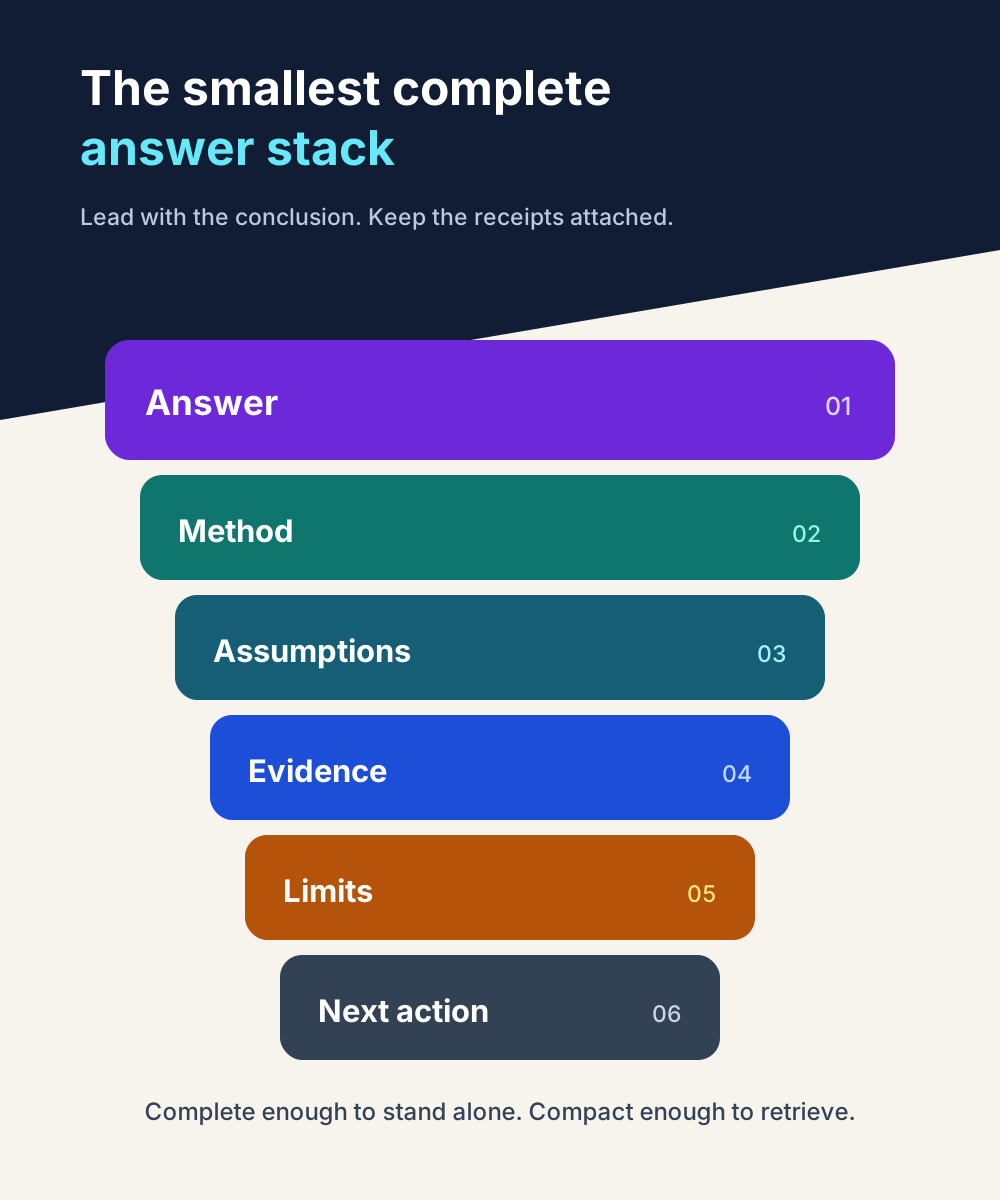
A strong valuation answer can usually be expressed in four parts:
- Answer: the direct conclusion;
- Basis: the method and inputs;
- Boundary: what the conclusion does not include;
- Action: what the reader should verify next.
For example:
That paragraph is answer-first, but it does not pretend to know a multiple for a business it has not examined. It also preserves the category boundary between a domain and a developed website.
Flippa's public website valuation calculator methodology illustrates the factors a marketplace may use. Its model begins with a 30× monthly-profit baseline for content sites and adjusts for risk and quality. That is Flippa's stated method, not a universal law or a guaranteed sale range.
Attribution is part of AEO. “Flippa says its calculator begins at 30×” is supportable. “Websites are worth 30×” is not.
Google's answer on AEO is still SEO
Google's 2026 guide to generative Search optimization says that AEO and GEO are names used for work focused on AI visibility, but from Google's perspective the work remains SEO.
Its systems retrieve from the Search index, apply established ranking and quality systems, and may use query fan-out to issue related searches. The same guide explicitly says that llms.txt and special AI markup are not required for Google Search.
That removes several distractions. A valuation publisher should invest in:
- a clear technical structure;
- original and non-commodity information;
- visible evidence and named sources;
- useful images, charts, and examples;
- internal links that connect methods, asset types, and risk factors;
- current pages with honest dates and revision notes.
The page must also be indexable and eligible to appear with a snippet. Google's AI features documentation says there are no additional technical requirements beyond those foundations and no special schema.org type for AI features.
Build answer blocks that retain their caveats
An answer engine may lift a paragraph, list, table, or heading section. Write each important block so it carries enough context to survive retrieval.
Define the asset before the method
A bare domain, content site, ecommerce store, SaaS business, newsletter, and social account do not share one valuation model. State the asset class in the answer itself.
Bad:
Better:
The second answer remains useful even when removed from the surrounding page.
Name the denominator and time period
“Profit” can mean last month, trailing twelve months, seller's discretionary earnings, EBITDA, or an unverified claim. “Traffic” can mean users, sessions, pageviews, Search Console clicks, or third-party estimates.
Every answer should name the measurement. If the page uses average monthly net profit over the prior twelve months, say that. If seasonality makes twelve months more appropriate than six, explain why.
Separate observation from inference
Observation: first-party analytics shows the measured share of sessions supplied by organic search during the period examined.
Inference: the business may deserve a concentration discount because one platform supplies most discovery.
The observation can be verified. The inference is a judgment. Clear labels make the answer more trustworthy and easier for a buyer to challenge constructively.
Use ranges when the evidence is uncertain
A point estimate looks precise, but valuation inputs are rarely precise. Ranges make uncertainty visible. They also let the page explain what would move an asset toward the low or high end.

Use formal valuation concepts without pretending to perform a formal appraisal
The International Valuation Standards organize professional work around bases of value, approaches, data and inputs, models, documentation, businesses, and intangible assets.
An educational article does not need to reproduce a professional standard. It should borrow the discipline:
- What is being valued?
- On what date?
- Under which definition of value?
- Which method is being used?
- Which inputs are observed, estimated, or assumed?
- Which material assets and liabilities are excluded?
- How sensitive is the conclusion to a changed input?
This structure creates better answers because it makes ambiguity harder to hide.
For automated estimates, add a visible boundary. Real Site Worth can orient an owner using public and user-supplied signals. It cannot verify private books, tax treatment, contracts, or undisclosed liabilities without the evidence.
Make the evidence easy to inspect
Link the claim near the sentence it supports. Do not hide all sources at the bottom and expect a reader to reverse-engineer the attribution.
Prefer sources in this order:
- regulators, standards bodies, and official technical documentation;
- primary marketplace or transaction data, clearly attributed;
- original research with a stated sample and methodology;
- expert secondary analysis where primary evidence is unavailable.
Avoid copying a number across a chain of blogs. If the original study cannot be found, remove the number or describe the point qualitatively.
Google's guidance on generative-AI content emphasizes accuracy, quality, and relevance. It also warns that generating many pages without adding value may violate the scaled-content-abuse policy.
For valuation content, “added value” should be visible. It can be a worked example, sensitivity table, calculation, source comparison, decision tree, original dataset, or a clear method a reader can reproduce.
Tables answer comparison questions well
Valuation searches often contain comparison intent. A compact table can make distinctions explicit.
Tables should not repeat prose merely to look structured. Use them when the relationship is genuinely easier to compare in rows.
FAQs should resolve residual intent
Google deprecated FAQ rich results in May 2026. That means an FAQ should exist because readers still have unanswered questions, not because the page expects a special search decoration.
Good FAQ questions do one of three jobs:
- clarify a boundary;
- answer a common objection;
- direct the reader to the next diagnostic step.
Avoid rephrasing the title six times. If the main article already answers “What is AEO?” fully, the FAQ should cover implementation limits, measurement, schema, updating, and risk.
How to measure AEO visibility and value
Start with a fixed prompt set that represents real valuation questions. Record whether your brand appears, which page is cited, whether the mention is accurate, and the date, model, market, and account state. Repeat the same prompts across major answer engines rather than saving only the best result.
Then connect brand mentions across AI platforms to owned evidence. Measure AI referrals, landing pages, valuation starts, completed reports, signups, and revenue where attribution exists. Search visibility and visibility in AI answers are discovery metrics; they are not substitutes for qualified demand or normalized earnings.
AI tools can help track brand mentions across AI, but monitoring scores are not a transferable asset. Search Console, analytics, server logs, CRM events, and first-party revenue provide the stronger buyer receipts. If the brand appears across ChatGPT and Google AI features but produces no measurable action, present that as an opportunity rather than a valuation premium.
A simple monthly evidence table is enough:
A valuation-content AEO checklist
Before a page is ready, test it at the passage level.
Answer quality
- Does the first paragraph answer the primary intent?
- Does every numeric claim name its source and measurement basis?
- Can the key paragraph be quoted without becoming misleading?
- Are observed facts separated from judgment?
- Does the page state uncertainty and exclusions?
Technical readiness
- Does the URL return a successful response?
- Is the page indexable and snippet-eligible?
- Can crawlers reach the main text and images?
- Do canonical and internal links point to the intended page?
- Does structured data match visible content?
Editorial differentiation
- Is there original analysis, a worked example, or a reusable framework?
- Does the page answer a distinct intent rather than cannibalize another article?
- Are update dates and methods visible?
- Are body visuals informative rather than decorative filler?
Conversion fit
- Does the CTA follow naturally from the answer?
- Does the page send a domain-only question to a domain appraisal?
- Does it send an operating-business question to a website valuation path?
- Does it avoid promising certainty the product cannot provide?

Frequently asked questions
What is answer engine optimization?
Answer engine optimization is the practice of making content easy for search and answer systems to retrieve, understand, and use accurately. For Google, the underlying work remains SEO rather than a separate technical standard.
Does AEO require special schema?
No special AI schema is required for Google AI Overviews or AI Mode. Use supported structured data only when it matches the visible content and the relevant Search feature.
Should every question become its own article?
No. If two queries produce the same intent and substantially the same answer, one stronger page is usually safer than two near-duplicates. Use SERP overlap and reader intent to decide.
What makes valuation content suitable for an answer engine?
A direct answer, named asset type, clear method, defined inputs, range or uncertainty, linked evidence, and an explicit boundary. The answer should remain accurate when read outside the full page.
Can AI write valuation articles safely?
AI can assist research organization and drafting. Every material fact, number, method, and source must still be checked. Automated fluency is not evidence.
How often should valuation content be updated?
Update when marketplace conditions, platform policies, tax guidance, product behavior, or source data changes. Display the date and describe material revisions where useful.
Continue through the RSW silos
Start with the website valuation complete guide, then see why website valuators disagree when inputs or assumptions differ. Reading the valuation band and valuation confidence intervals show how answer-first copy should communicate uncertainty.
The owner-facing website-worth guide connects that explanation to a real decision, while RSW's methodology documents the calculation boundary.
Turn the answer into an evidence-based estimate
Good AEO gets the reader to the right answer. A good valuation product makes the assumptions inspectable after they arrive.
Use Real Site Worth to establish an automated starting range, then test the result against earnings, traffic quality, concentration, transferability, and the evidence behind the asset.
- Google Search Central — Optimizing for generative AI featuresdevelopers.google.com
- Google Search Central — AI features and your websitedevelopers.google.com
- Google Search Central — Guidance on generative-AI contentdevelopers.google.com
- International Valuation Standards Council — 2025 International Valuation Standardsivsc.org
- Flippa — Website Valuation Calculator methodologylanding.flippa.com

Keep moving through the AI search and website value silo
GEO, AEO, LLM SEO, ChatGPT, and AI Overview evidence for website valuation and acquisition diligence.
