

In this piece · 17 sections
- The valuation question
- What does “rank in ChatGPT” mean?
- How does ChatGPT rank websites?
- SEO for ChatGPT: practical, verifiable steps
- How to get cited by ChatGPT
- Ranking signals buyers can verify
- First, define what “visible in ChatGPT” means
- Audit the three OpenAI access paths separately
- Test the actual public response
- Reproduce source-link claims without overstating stability
- Connect ChatGPT visibility to first-party measurement
- Audit the content that earned the source link
- Review concentration and policy risk
- Translate the audit into valuation treatment
- Frequently asked questions
- Continue through the RSW silos
- Price the evidence, not the claim
The valuation question
A seller says the website “ranks in ChatGPT.” That can mean at least five different things:
Those claims are related, but they are not interchangeable. ChatGPT SEO due diligence turns the claim into verifiable parts before it affects price.
This is a narrower audit than general LLM SEO diligence. It focuses on OpenAI's documented discovery path, observable ChatGPT outputs, referral measurement, and the business assets behind them.
What does “rank in ChatGPT” mean?
ChatGPT does not publish a stable numbered ranking comparable to a traditional search engine results page. To rank in ChatGPT usually means that a brand or page appears in ChatGPT answers for a relevant prompt, receives a citation, or earns referral traffic. Each outcome needs a different receipt.
ChatGPT ranking is therefore sampled visibility, not a permanent position. The same query can produce different sources by product mode, date, market, account state, and follow-up context. A seller who says the site is “number 1 in ChatGPT” should provide the exact prompt and output instead of treating the claim like a keyword rank.
For a buyer, the useful question is not only how to rank on ChatGPT. It is whether the brand mentions, cited pages, traffic, conversions, and content systems are durable enough to transfer.
How does ChatGPT rank websites?
OpenAI does not describe a single public ranking formula. ChatGPT Search can retrieve web sources and cite supporting links, while other ChatGPT responses may use different context. Search discovery, user-triggered retrieval, and model training are separate access paths.
That means ChatGPT uses more than on-page keyword repetition. Relevant, authoritative content; clear entities; accessible pages; original evidence; backlinks and mentions across the web; and accurate third-party references can all support discoverability. Platforms like ChatGPT may also rely on search indexes or sources outside the publisher's control.
Traditional SEO still matters. A clean search engine foundation helps both Google and ChatGPT find and interpret the site. However, no SEO agency, monitoring tool, or content publisher can guarantee that ChatGPT will cite a particular page for every prompt.
SEO for ChatGPT: practical, verifiable steps
Use ChatGPT visibility as an extension of the site's SEO strategy, not a separate promise. These SEO strategies improve assets a buyer can inspect:
- Ensure your site is accessible. Test robots rules, page directives, rendering, canonical tags, structured data, and public-edge responses.
- Map the target audience and search intent. Use a fixed prompt set that reflects real buyer questions, not prompts designed only to force the brand into an answer.
- Create content with information gain. Original datasets, tools, experiments, expert review, and firsthand examples give AI-generated answers a defensible source.
- Build authority across the web. Earn accurate brand mentions, relevant backlinks, digital PR, and third-party references. A discussion on Reddit can be useful evidence, but it is not owned.
- Keep content fresh. Update changing facts, dates, screenshots, methods, and product claims before stale passages spread into AI answers.
- Measure outcomes. Track linked sources, referral sessions, landing pages, conversions, and branded search rather than reporting a monitoring score alone.
Optimizing for ChatGPT is not a way to control ChatGPT responses. It is a process for making the site technically available, factually clear, and worth citing while documenting the limits.
How to get cited by ChatGPT
To get cited by ChatGPT, make your content easy to retrieve, attribute, and verify. ChatGPT pulls sources that support an answer, but source selection changes with the prompt and available context. Fresh content helps only when the update adds accurate evidence rather than changing a date cosmetically.
Generative engine optimization can improve AI search visibility by strengthening the same assets used by traditional search engines: technical access, clear entities, authoritative coverage, and trustworthy third-party mentions. If the brand gets mentioned without a link, record it separately from traffic.
Measure visibility across the prompt set and compare it with SEO performance. A page can rank in AI search without creating a visit, while a cited tool can attract qualified demand. The objective is not simply to boost visibility on ChatGPT; it is to connect discovery to a business result a buyer can reproduce.
Ranking signals buyers can verify
There is no disclosed checklist of universal ChatGPT ranking factors. Buyers can still audit the inputs that support ranking across traditional search and AI search: technical access, topic relevance, original evidence, authority, accurate brand mentions, backlinks, and current content.
Test ranking claims against a repeatable query set. Ask the assistant the same buyer-intent questions over time, record the answer and cited URL, and compare the observation with keyword rankings and Google Search Console. This separates assistant exposure from ordinary ranking without pretending either is fixed.
LLMs may retrieve different sources as context changes. To optimize responsibly, make your content easy to verify and keep important facts consistent across third-party web sources. Do not optimize by hiding repetition or publishing pages for every prompt variant.
For a B2B website, include commercial prompts that reflect the target audience's real evaluation process. Asking ChatGPT only broad informational questions can exaggerate visibility while missing the terms closest to leads and revenue.
First, define what “visible in ChatGPT” means
Ask the seller to choose the exact claim:
- Mention visibility: the answer names the brand but may not link it.
- Linked-source visibility: the answer includes a supporting link to the site.
- Referral traffic: a user follows the link and arrives at the site.
- Conversion: that visit completes a meaningful action.
- Brand effect: exposure contributes to later branded search or direct demand.
Each layer needs different evidence. A source link does not prove a visit. A visit does not prove revenue. A monitoring score does not prove that a buyer can reproduce the result.
Record the claim before opening any dashboard. Otherwise the diligence process can drift toward whichever metric looks best.
Audit the three OpenAI access paths separately
OpenAI's current publisher and developer FAQ says public sites can appear in its search experience and advises publishers not to block OAI-SearchBot if they want content included in summaries and snippets.
Cloudflare's crawler reference identifies three distinct OpenAI agents:
Do not assume one robots rule controls all three in the intended way. Capture the current robots.txt, the source that generates it, and any page-level directives.
Then test the public edge. OpenAI notes that WAFs, CDNs, bot mitigation, JavaScript challenges, authentication, and geography rules can block an otherwise allowed crawler. A rule that says “Allow” is not proof that the agent receives a successful, useful page.
Test the actual public response
Choose a representative set of URLs:
- homepage and brand explanation;
- primary calculator or product page;
- top cited article;
- newest article;
- one JavaScript-heavy route;
- one URL previously blocked or redirected.
For each URL, preserve:
- final status code;
- redirect chain;
- canonical tag;
- robots meta and response headers;
- rendered title, main text, byline, and date;
- structured data that matches visible content;
- edge or server-log evidence where available.

A seller may show a healthy origin while the public hostname returns a challenge, maintenance page, or 503 to automated clients. Buyer-path evidence must use the production route.
OpenAI's FAQ also describes a subtle boundary: if a disallowed page URL is learned from another source, ChatGPT may still surface the title and link in certain cases. If the publisher wants to prevent that, noindex must be readable. Blocking the crawler before it can see noindex may not create the expected outcome.
The diligence objective is not to prescribe one policy. It is to confirm that stated intent and deployed controls agree.
Reproduce source-link claims without overstating stability
Request the seller's monitoring pack:
- exact prompts;
- date and time;
- ChatGPT product or mode;
- account state and geography where relevant;
- full answer, not a cropped mention;
- cited URL;
- whether the answer was regenerated;
- observation frequency.
Re-run a sample. A different result does not automatically invalidate the earlier receipt. Generative answers change. It does show why a one-time screenshot should not be treated as recurring performance.
Check source accuracy as well as presence. A confident but wrong description can create support cost, reputational risk, or a misleading buyer narrative. Identify which page contains the statement ChatGPT appears to be using and whether the page is current.
For high-value claims, record stability as a time series: checks present divided by checks run. Do not collapse that into “ranks #1.” ChatGPT answers are not a fixed ten-link result page.
Connect ChatGPT visibility to first-party measurement
OpenAI says publishers that allow OAI-SearchBot can track ChatGPT referral traffic in analytics products. Start with source/medium and landing-page reports, then inspect conversions.
Ask for:
- ChatGPT-attributed users, sessions, and landing pages;
- report definition and filters;
- observation period;
- engagement and conversion events;
- revenue or lead quality where material;
- comparison with direct, organic, and referral traffic;
- changes in tracking implementation.
GA4 explains that direct / none includes visits without clear referral information. Redirects, stripped parameters, blockers, and other technical conditions can cause that classification.
That makes ChatGPT traffic a measurement range rather than a perfect count. Use attributable referrals as the lower-confidence floor and disclose what cannot be separated from direct. Do not add an invented “dark AI” multiplier.
Test conversion, not just arrival
An AI referral may be more informed because the answer supplied context before the click. That hypothesis must be tested on the site.
Compare useful outcomes:
- valuation starts and completions;
- lead forms;
- account registrations;
- email subscriptions;
- assisted conversions;
- return visits;
- revenue, if the sample is large enough.
Name the sample. A high conversion rate from a handful of visits may look impressive and still be too small for a durable forecast.
Audit the content that earned the source link
Find the reason the page is citeable. Common candidates include original data, a clear definition, a table, a calculation, an expert quote, a product fact, or a distinctive example.
Then verify ownership and maintenance:
- Who wrote and reviewed it?
- Does the byline transfer with the business?
- Are screenshots and images licensed?
- Can the buyer retain the dataset or API?
- Are sources and update triggers documented?
- Does the page make claims outside the author's expertise?
- Is the useful passage surrounded by caveats that disappear when quoted?
Flippa's due-diligence checklist tells buyers to verify asset ownership, request direct analytics evidence, reconcile revenue, and confirm monetization. ChatGPT-visible content belongs in that asset inventory.
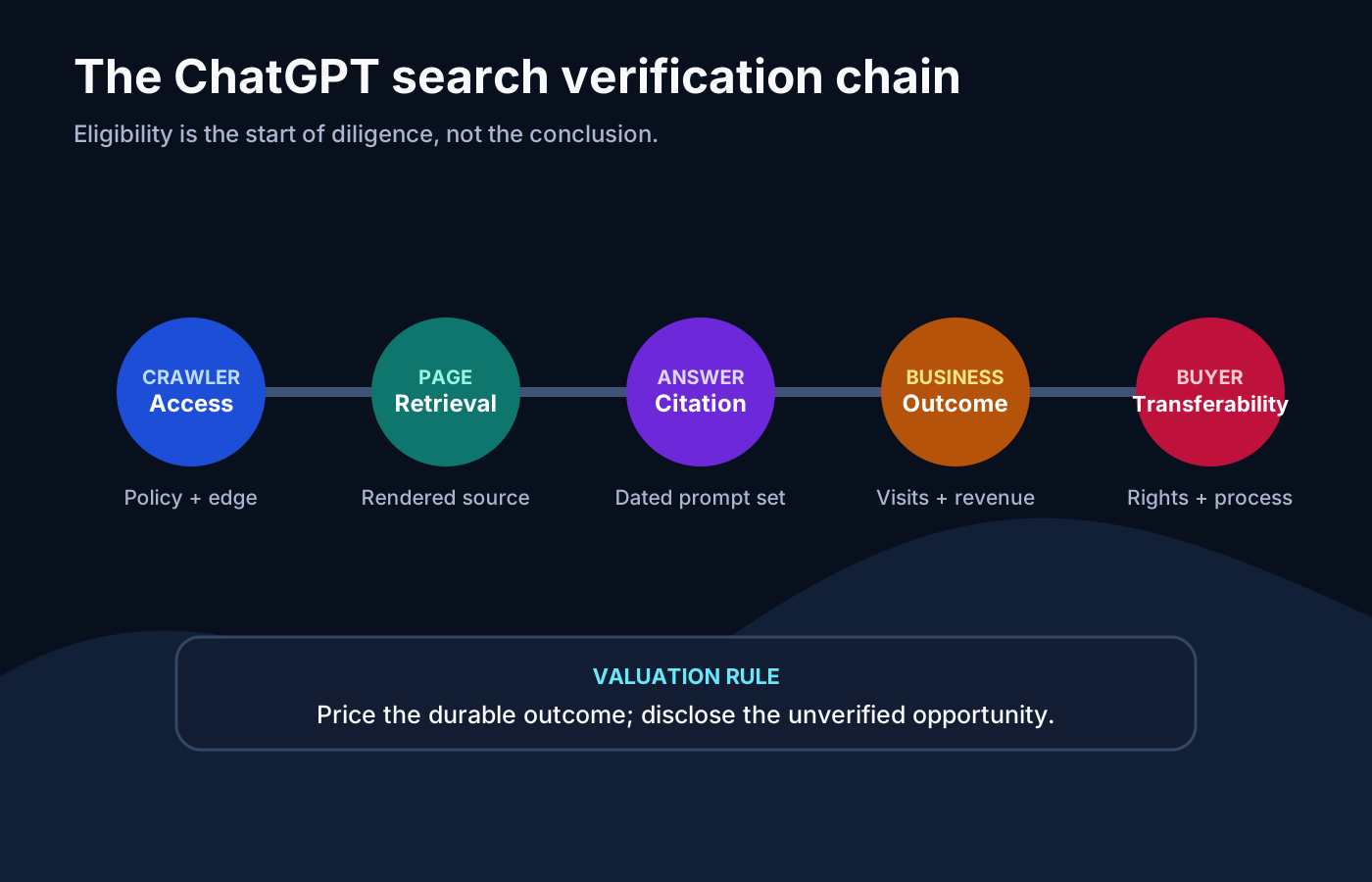
If the page depends on a founder's personal authority or a non-transferable research relationship, the visibility may decline after the sale. Treat that as owner dependency.
Review concentration and policy risk
A site with meaningful ChatGPT discovery has a new channel, but it may also have a new dependency.
Measure:
- percentage of total traffic attributable to ChatGPT;
- percentage of ChatGPT traffic landing on the top one, three, and ten pages;
- percentage of monitored mentions tied to one prompt family;
- dependence on one author, dataset, or third-party mention;
- overlap with Google-indexed traffic and the same underlying pages.
Do not call the business diversified merely because users arrive through a different interface. If the cited pages depend on the same search index, source corpus, or brand mention as the organic channel, the underlying concentration may remain.
Review current policy controls. A future owner may choose to allow Search while blocking training, or may have contractual reasons to restrict particular content. The deal package should state the current policy and who can change it.
Translate the audit into valuation treatment
Use four buckets:
Verified performance
Recurring attributable traffic and conversions, reconciled with total analytics. Include once in normalized business performance.
Durable owned assets
Original research, brand authority, useful tools, transferable content rights, clean technical architecture, and documented editorial systems. Consider within content quality, brand strength, replacement cost, and operational risk.
Unverified opportunity
Mentions and linked sources without reliable traffic or conversion evidence. Describe the upside, but do not capitalize them as recurring income.
Remediation and concentration risk
Blocked crawlers, inconsistent directives, edge challenges, owner-dependent authority, missing rights, or traffic concentrated in one cited page. Estimate the work and apply an appropriate risk adjustment.

Frequently asked questions
Does allowing OAI-SearchBot guarantee linked sources?
No. It helps OpenAI discover content for Search, but inclusion, wording, placement, and persistence are not guaranteed.
Is GPTBot the crawler used for OpenAI search?
OpenAI and Cloudflare document OAI-SearchBot separately from GPTBot. Audit search discovery, user retrieval, and training as different purposes.
Can the assistant cite a page that blocks crawling?
OpenAI says it may surface a title and link learned through another source in certain cases. Page-level noindex controls require crawler access to be read, so policy design needs care.
Is ChatGPT traffic visible in Google Analytics?
Some attributable referrals can be visible. Some visits may lose referrer information and appear as direct. Verify the implementation and disclose the measurement limitation.
How much value should one assistant citation add?
There is no defensible fixed amount. Evaluate durability, traffic, conversion, brand effect, underlying asset quality, concentration, and transferability.
What is the fastest buyer test?
Reproduce a sample of citations, test the cited URLs through the public edge, inspect analytics access, and trace one citation from prompt to page to visit to conversion. That exposes most unsupported leaps.
Continue through the RSW silos
The website valuation pillar supplies the base model. Use social-signals valuation for off-site mentions, traffic concentration for platform dependence, and technical-risk valuation for crawl and infrastructure weaknesses.
RSW's methodology defines what the engine can verify, and the free calculator establishes the range before ChatGPT visibility is treated as upside.
Price the evidence, not the claim
Assistant visibility can be useful. The acquisition value sits in measurable demand and the transferable content, technical, and brand systems that created it.
Run an independent website estimate, then reconcile the result with verified earnings, traffic quality, citation evidence, concentration, and remediation work.
- OpenAI — Publisher and developer FAQhelp.openai.com
- Cloudflare — AI crawler referencedevelopers.cloudflare.com
- Cloudflare — Manage AI crawlersdevelopers.cloudflare.com
- Google Analytics — Understand direct/none trafficsupport.google.com
- Flippa — Due diligence checklistflippa.com

Keep moving through the AI search and website value silo
GEO, AEO, LLM SEO, ChatGPT, and AI Overview evidence for website valuation and acquisition diligence.
